 The meeting starts in two minutes. The puppy has other plans.
You sit down to answer one email. Bark. You stand up to make dinner. Bark, bark. You pick up your phone. Bark, bark, bark, eyes locked on yours, tail going. Your puppy is not scared and not hurt. They want something, and they have figured out that noise gets it.
That is demand barking, and it wears people down fast. One r/puppy101 post titled "Cannot stand the demand barking, what do I do?" (thread) drew 86 replies. In our scan of Reddit barking threads, "demand barking" was one of the most common phrases owners used.
Here is the hopeful part. Demand barking is learned, so it can be unlearned. This page brings together what Preventive Vet, the ASPCA, Cornell's Riney Canine Health Center, and the VCA say works, plus what real owners found on Reddit. LoveMyPuppy sells a handheld bark deterrent, and we will be clear it is not for young puppies.
Quick answer: How do you stop puppy demand barking? Make sure your puppy's real needs are met first, like a potty break, food, rest, and play. Then stop paying off the bark: turn away or step out of the room, and give attention the moment your puppy is quiet. Teach a polite way to ask, like a sit or a nose nudge, and reward it before barking starts. Expect it to get louder for a bit before it gets better.
On this page
- What is puppy demand barking?
- Is it demand barking or a real need?
- Step 1: Meet the need before the bark
- Step 2: Stop paying off the bark
- Step 3: Teach a polite way to ask
- Why ignoring can make it louder first
- Demand barking at dinner, in the crate, and at night
- What owners on Reddit say worked
- Which demand barker do you have?
- Where a bark deterrent fits, and where it does not
- Frequently asked questions
Key Takeaways
- Cornell describes demand barks as a dog who seems to demand a treat or that you do something for them.
- Preventive Vet says even looking at your dog and yelling "no" can be the attention they wanted.
- The ASPCA says to turn away, look at the ceiling, or leave the room, then reward the instant your dog is quiet.
- Barking often gets worse before it gets better: trainers call this an extinction burst.
- Teaching a polite way to ask works faster than ignoring alone.
What is puppy demand barking?
Cornell's Riney Canine Health Center describes attention seeking or demand barks this way: "your dog really does seem to demand that you give them a treat, or do something for or with them."
The ASPCA puts it in plain terms: some dogs bark at people "to gain attention or rewards, like food, toys or play."
Preventive Vet explains how it starts. Demand barking often grows out of excitement barking. A puppy barks, we look at them, toss the toy, or say their name, and the puppy learns that barking works. As Preventive Vet puts it, looking at your dog and yelling NO "is, in essence, giving them what they wanted."
Is it demand barking or a real need?
Before you treat it as demand barking, rule out a real need: young puppies bark for good reasons too.
| Sign | Likely demand barking | Possibly a real need |
|---|---|---|
| Body language | Loose, bouncy, eyes on you | Pacing, whining, panting, trembling |
| Timing | When you sit, eat, or work | After a long stretch without a potty break or meal |
| Stops when | You look, talk, or give in | The need is met |
| In the crate | Short protest, then settles | Panic, drooling, chewing the bars |
If your puppy might need to potty, take them out calmly and bring them back with little fuss. If the barking looks like panic or happens every time you leave, that is not demand barking. The ASPCA says separation related barking needs a different plan, and a vet or behavior professional can help.
One r/puppy101 owner put the worry well in a post asking whether their puppy's crate barking was demand barking or real distress (thread). If you are not sure, err on the side of checking: our guide to puppy crying in the crate at night walks through how to tell.
Step 1: Meet the need before the bark
A puppy who is bored, tired, or full of energy will bark more: Preventive Vet says extra physical exercise and mental enrichment can help when a dog is overstimulated.
- Plan play before you sit down to work. A short game and a potty break first.
- Give a job. A chew or a food puzzle while you eat or take a call.
- Protect naps. Overtired puppies often get louder, not quieter.
- Set up the space. Have the chew ready before you start cooking, not after the barking begins.
Step 2: Stop paying off the bark
 Crystal clear body language: barking gets nothing. Quiet gets everything.
The ASPCA's advice is to use "crystal clear body language" to show that barking for attention will fail. When your dog starts to bark for attention, you can stare at the ceiling, turn away, or walk out of the room. The instant your dog stops barking, ask for a sit and then give them what they want, whether that is attention, play, treats, or going outside. And try your best never to reward barking at you again.
Preventive Vet adds the same idea. If your dog barks during fetch, the ball goes away and you look away. If your dog barks for attention, you stand still and look away, turn your back, or step into another room.
This works best when everyone in the house does the same thing: one person giving in now and then teaches your puppy to keep trying longer.
Step 3: Teach a polite way to ask
 Catch the quiet sit before the bark, and make a big deal of it.
Ignoring tells your puppy what does not work: you also need to show them what does.
Preventive Vet suggests choosing a behavior you would like your dog to use to ask for attention, like sitting quietly or a gentle nudge, and then rewarding it every time, ideally before barking starts. If your dog approaches and sits on their own, it says to have "an even bigger praise party."
Easy ways to start:
- Watch for calm moments. When your puppy is lying quietly or chewing a toy, walk over and give a treat or a calm pat.
- Ask for the sit first. When your puppy comes to you, ask for a sit before the barking starts and reward it.
- Teach a nose nudge. Hold your hand out, reward a touch of the nose, and use it as their way of saying "hey."
Why ignoring can make it louder first
You stop answering the bark, and the next day it is worse: that does not mean the plan failed.
Preventive Vet calls this an extinction burst: behavior gets more intense, louder and more persistent, before it fades. A dog who has learned that barking gets attention will often bark more when it suddenly stops working. If you give in at the loudest moment, your dog learns that louder barking works.
Preventive Vet also says the more you reward a calm alternative, the faster these bursts pass. It does not give a set number of days, and how long it lasts depends on how long barking has worked for your dog.
One more caution: do not use "it is an extinction burst" as a reason to ignore a puppy who looks distressed. If the barking turns into panic, stop and check what your puppy needs.
Demand barking at dinner, in the crate, and at night
At dinner. One r/puppy101 owner described their trainer's advice for a dog who barked while food was being poured: "What worked was when he started barking, I would stop pouring the food, ignore him, and walk away. I'd only come back when he was calm." (comment)
In the crate. Short protest barking after a walk and potty break is common. Panic is not. If you are not sure which you are hearing, check calmly. See our puppy crying in the crate at night guide for a full plan.
At night. Young puppies often need a potty break overnight. Take them out quietly, then straight back to bed with no play, so the night trip stays boring.
At the TV. If your puppy barks at you every time you sit down to watch, that is often a bid for attention. If they bark at doorbells on screen, that is a different trigger. Our guide to why a dog barks at the doorbell on TV covers that one.
What owners on Reddit say worked
We read through the most active demand barking threads in r/puppy101 and r/puppytraining: here is what owners said helped.
Teach a different way to ask. "Teach a different attention getting behavior! I taught my pup to "nudge" (push his nose into me) when he started doing it and while it's taken a long time to get it through to him he is starting to catch on." (comment)
Do not let it work. One owner shared what a trainer told them after five sessions: "dogs do what works for them, so don't let it work." (comment)
Reward the quieter version. "I ended up treating her every time she peeped or whined but didnt bark. The barking toned down almost immediately." (comment)
Ignore, then reward quiet. The top reply on another thread, with 39 upvotes: "Yep, completely ignore her, don't look at her, don't talk, act like she doesn't exist. Once she stops barking give her attention." (comment)
And on a thread titled "Demand barking break through!" with 72 upvotes, one reply summed up the hard part: "It's definitely not easy to ignore a loud dog but the results are worth it!" (thread)
These are owners' own stories, not studies, but they line up with what Preventive Vet and the ASPCA recommend. For more owner stories checked against vet advice, see our lessons from Reddit on letting a puppy bark it out.
Which demand barker do you have?
These are invented examples, not real customers.
The work from home heckler. Your 4 month old barks every time you join a call. Play and a potty break before the call, a chew in a pen beside you, and a treat for every quiet minute at first.
The dinner DJ. Your 7 month old barks while you fill the bowl. Stop pouring when the barking starts, wait for quiet, then continue. Ask for a sit before the bowl goes down.
The couch campaigner. Your 1 year old barks at you every evening until you play. Plan a game before you sit down, then teach a nose nudge as the new way to ask.
Where a bark deterrent fits, and where it does not
Let us be straight: for most puppy demand barking, you do not need a device. The steps above are what Preventive Vet and the ASPCA recommend.
The AKC's barking guide says spray collars, ultrasonic devices, and electronic collars work by punishment, are no more effective than positive reinforcement, and that you should talk to a certified trainer or behaviorist before using one. The VCA says audible and ultrasonic devices are usually not reliable on their own. The ASPCA says noise collars are ineffective with most dogs.
LoveMyPuppy's handheld bark trainer is not for young puppies. Its product page says it is for dogs 6 months to 8 years, "Not for younger puppies or dogs who seem frightened by the cue," and that you should stop if the cue frightens your dog. If your puppy is under 6 months, skip it and stick with the steps above.
Where it can fit is an older puppy or adult dog, 6 months to 8 years, whose barking happens at predictable moments, like the doorbell, and who is not fearful. The VCA describes interrupting barking with a device such as an ultrasonic trainer during structured training, then rewarding a quiet sit or stay. The product page says the same thing in its own words: use a brief cue, then reward the calmer choice.
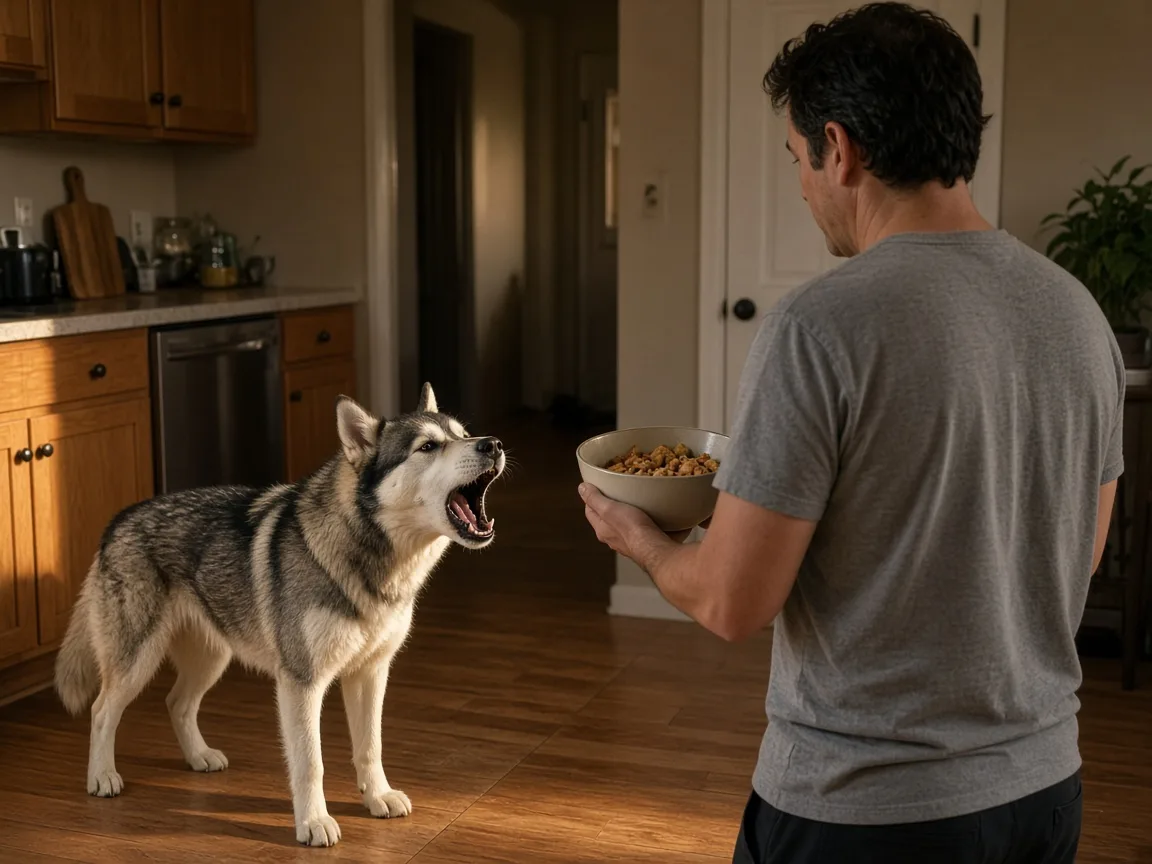 The bowl stops moving when the barking starts. It moves again when your dog is calm.
If your dog is between 6 months and 8 years, confident, and still barks at predictable triggers after you have tried the steps above, Click Here to see how the handheld cue works and who it is not for.
Click Here If Your Dog Is 6 Months To 8 Years
If the barking is already causing trouble with the people next door, see what to do when a neighbor is complaining about dog barking.
Frequently asked questions
What is puppy demand barking?
It is barking to get something, like attention, food, play, or a door opened. Cornell describes demand barks as a dog who seems to demand that you give them a treat or do something for them.
How do I stop my puppy from demand barking?
Meet real needs first, then turn away or leave the room when your puppy barks for attention, and reward the instant they are quiet, as the ASPCA describes. Teach a polite way to ask, like a sit or nose nudge.
Why is my puppy's demand barking getting worse when I ignore it?
That is often an extinction burst: Preventive Vet says behavior can get louder and more persistent before it fades. Stay consistent and reward calm behavior, but stop and check if your puppy looks distressed.
Should I say "no" or "quiet" when my puppy demand barks?
Preventive Vet says looking at your dog and yelling "no" can give them the attention they wanted. Calmly turning away and rewarding quiet works better.
How long does demand barking last?
There is no set timeline. Preventive Vet says it depends on how long barking has worked for your dog, and that rewarding a calm alternative makes the loud phase pass faster.
Is it demand barking or separation anxiety?
Demand barking happens when you are there and stops when the dog gets what they want. Barking that happens every time you leave, with pacing or panic, may be separation related: the ASPCA suggests help from a behavior professional for that.
What about demand barking in the crate?
Check needs first, like a potty break. Short protest barking that settles is common. Panic, drooling, or chewing the bars is not demand barking. Talk to your vet if you are unsure.
Can I use a bark deterrent on my puppy?
Not on a puppy under 6 months. LoveMyPuppy's handheld cue is for dogs 6 months to 8 years who are not fearful, and the AKC suggests talking to a trainer before using any device.
Reviewed November 16, 2026. Advice checked against Preventive Vet, the ASPCA, Cornell's Riney Canine Health Center, the VCA, and the AKC. Product details come from the LoveMyPuppy product page. Personas are invented examples. If your puppy seems fearful, unwell, or in pain, talk to your vet.