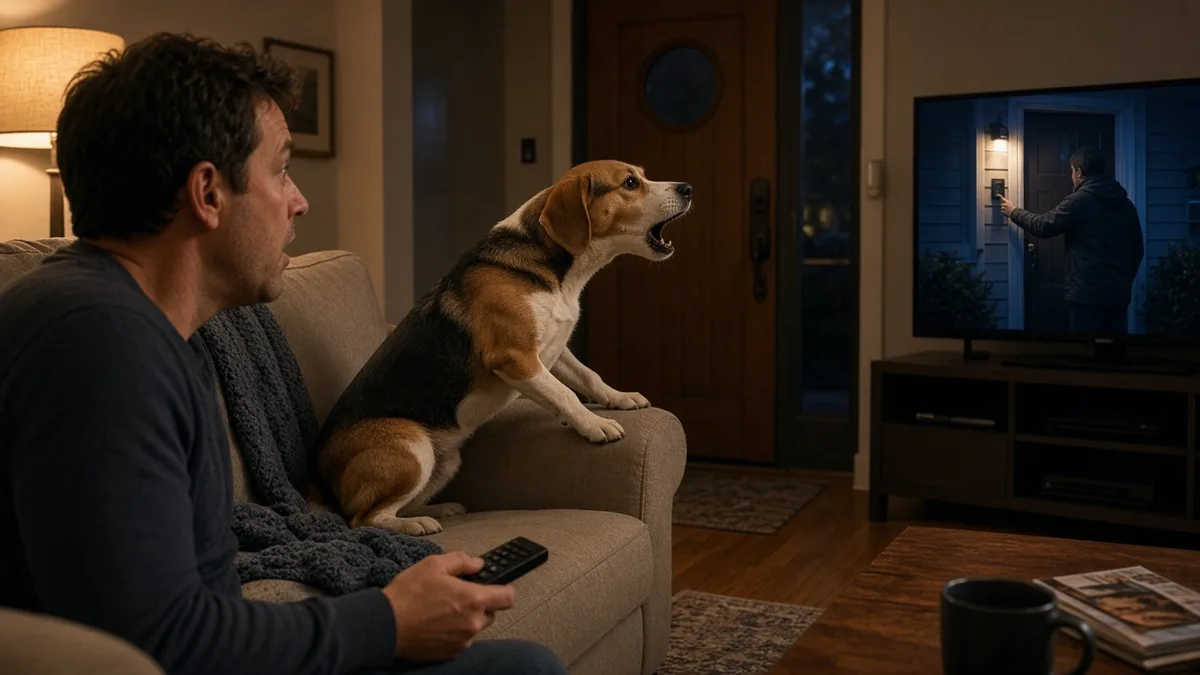
 Nobody is at the door. Try telling that to the dog.
You finally sit down for the show you have been saving all week. Ten minutes in, someone on screen rings a doorbell. Your dog launches off the couch, races to the front door, and barks like the house is being invaded. You pause, rewind, and miss the line again, then an ad comes on with a knock, and it starts all over.
If your dog barks at the doorbell on TV, you are in big company. One r/Dogowners thread asking "Do your dogs bark when the doorbell rings on TV shows?" drew 92 replies, and one of the top answers was two words long: "Every time." (comment)
The good part is that TV doorbells are one of the easiest triggers to practice with, because you control the remote. This page brings together what the VCA, Cornell's Riney Canine Health Center, the ASPCA, the AKC, and Preventive Vet say about it. LoveMyPuppy sells a handheld bark deterrent, and we will tell you plainly where it fits and where it does not.
Quick answer: Why does my dog bark at the doorbell on TV? The VCA says dogs cannot tell the difference between noises on the TV and noises in real life, so a TV doorbell sounds like a visitor. To stop it, lower the volume, give a treat the moment the doorbell sound plays, keep treating while your dog stays quiet, and stop when the sound ends. Practice with recorded scenes first: if your dog trembles, hides, or cannot settle afterward, talk to your vet.
On this page
- Why dogs bark at doorbells on TV
- Is it alert barking or fear?
- Step 1: Take the volume down
- Step 2: Make the TV doorbell mean a treat
- Step 3: Give your dog a TV time job
- Step 4: Practice with the real doorbell too
- What owners on Reddit say
- Which TV barker do you have?
- Where a bark deterrent fits
- Frequently asked questions
Key Takeaways
- The VCA says dogs cannot tell TV noises like a doorbell from real ones.
- Cornell lists a doorbell on television as a classic trigger for alert barking.
- The fix is to make the sound predict a treat, starting at low volume.
- A study reported by Science News found more anxious dogs reacted badly to TV doorbells and doors opening, so fear needs a gentler plan.
- A handheld bark deterrent is, at most, a brief interrupter for a confident adult dog during practice.
Why dogs bark at doorbells on TV
Your dog is not being silly: from where they sit, a doorbell is a doorbell.
The VCA puts it directly: dogs "can't tell the difference between noises on the TV and noises in real life, for example, a doorbell or a dog barking." It adds that a high volume makes those sounds stand out more, and that dogs may bark because they hear a sound with no matching smell of a person or animal, which can be confusing.
Cornell's Riney Canine Health Center calls this alert or alarm barking: it says alert barking can be set off by "less obvious events too, such as a neighbor slamming their car door or a doorbell on television."
The ASPCA says a dog who barks at any noise or sight, in any setting, is probably alarm barking, and these dogs often have stiffer body language than a dog who is barking to say hello.
| What you see | What it often means | What helps most |
|---|---|---|
| Runs to the door, barks, then looks back at you | Alert barking | Treat routine and a TV time job |
| Stiff body, barks at every sound in the house | Alarm barking | Lower volume, slower practice |
| Trembles, hides, or cannot settle for a long time | Fear or anxiety | Vet visit, behavior professional |
| Barks at you when you sit down to watch | Attention barking | See our puppy demand barking guide |
Is it alert barking or fear?
This matters, because the plan changes.
A Science News report on an Auburn University study of dogs and TV found that more anxious dogs responded negatively to sounds like doorbells or doors opening. A Tufts animal behaviorist quoted in the piece warned that TV can sometimes be "too much" and overstimulating.
So watch your dog the next time it happens: a dog who barks twice, trots to the door, and comes back wagging is probably alerting. A dog who startles from sleep, paces, and takes ages to calm down may be scared. One r/puppy101 owner described exactly that: "My pup will leap up from a dead sleep if a doorbell rings on TV, then runs barking to the door. Takes a while to settle afterward." (thread)
If your dog looks fearful, keep practice very gentle and talk to your vet: the ASPCA says to have a dog checked by a vet to rule out medical causes before working on a barking problem, and that punishment can make fearful barking worse.
Step 1: Take the volume down
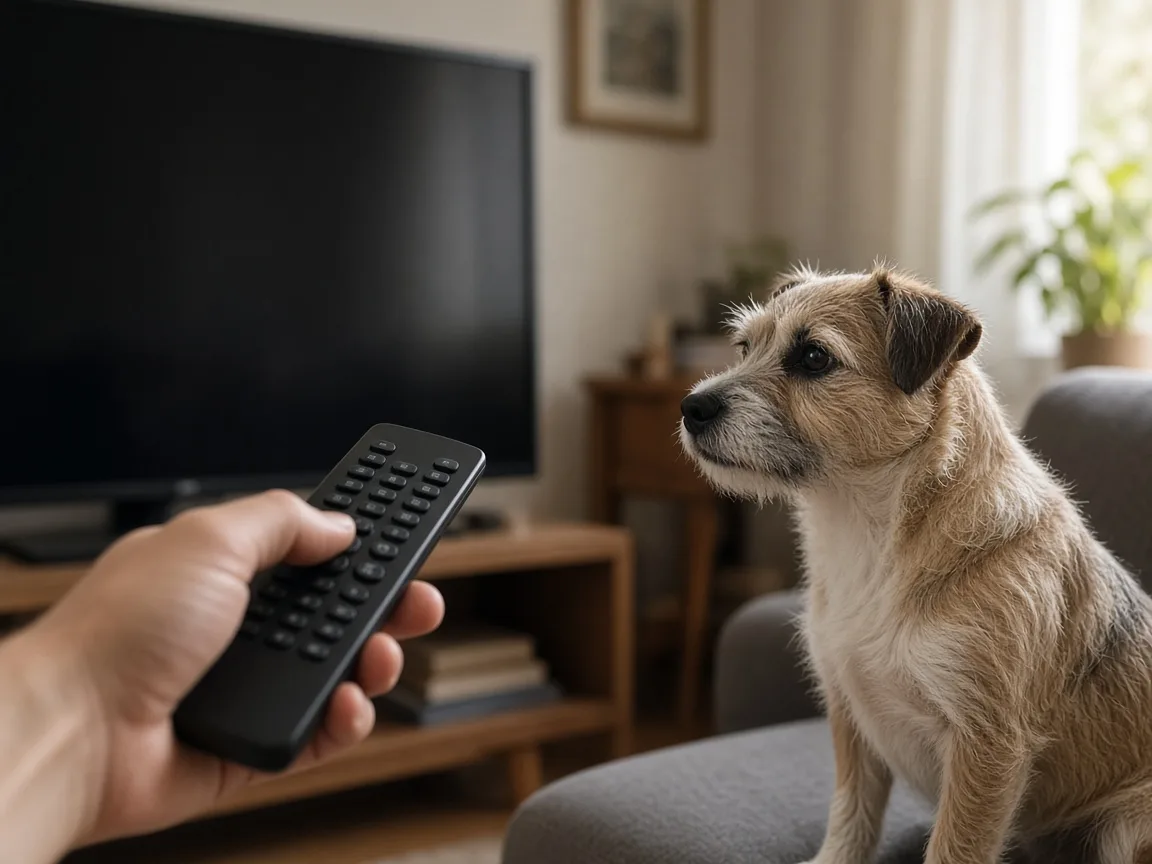 Lower volume makes the sound easier for your dog to hear without exploding.
Every time your dog barks at a TV doorbell and runs to the door, they practice the habit, so first, cut down the practice.
- Lower the volume. The VCA notes that keeping the volume high makes these sounds more noticeable.
- Know your triggers. Doorbells, knocks, and barking dogs in ads are common ones.
- Skip or mute the worst scenes for now, while you train.
- Let your dog rest farther from the speakers, so the sound is less intense.
This is not forever. It is a way to keep evenings calmer while you train.
Step 2: Make the TV doorbell mean a treat
 The doorbell rings on screen. A treat appears. Over time, that is the new pattern.
This is the core of the plan, and it is the one the VCA recommends for dogs who bark at the TV.
The VCA's version goes like this: as soon as the triggering sound comes up, give your dog a treat and keep treating as long as they stay quiet. Pause to let them look back at the screen, then give a few more treats, as long as they keep quiet. Stop when the trigger leaves the screen. Over time, instead of barking, your dog will look at you for a treat.
Preventive Vet calls a similar method "open bar, closed bar." The treats start when the trigger appears and stop when it goes away. The order matters, it says: the food must come after the trigger, not before.
How to make it work at home:
- Use recorded shows. Find a scene or ad with a doorbell you can replay.
- Start quiet. Play the doorbell at a volume your dog notices but does not bark at.
- Treat right after the sound. Small, soft treats, one after another while it plays.
- Stop the treats when the sound stops.
- Raise the volume slowly over several short sessions, only as fast as your dog stays quiet.
If your dog barks, the sound is too loud for now: turn it down and make the next try easier.
Step 3: Give your dog a TV time job
A busy, tired dog has less reason to react: the VCA suggests three easy additions:
- A chew or stuffed food toy during your show, so their mouth is busy.
- Exercise before TV time, like a walk or a game of fetch.
- Play or a short game when you first turn on the TV.
You can also teach a "go to place" cue on a bed near you. The AKC says sending a dog to a bed or mat when the doorbell rings gives them something to do instead of barking: it works for TV doorbells too.
Step 4: Practice with the real doorbell too
Owners notice this a lot: some dogs learn the TV doorbell is no big deal and still go off at the real one, or the other way around.
That is why the AKC and shelter trainers move on to the real doorbell, with a helper ringing it while you reward quiet or a trip to the mat. Our guide on how to stop dog barking at the door walks through that step by step.
If the barking also bothers people next door, see our guide on what to do when a neighbor is complaining about dog barking.
What owners on Reddit say
We read through dozens of Reddit threads on TV doorbells and knocks: a few patterns stood out.
Many dogs have never heard a real doorbell. The r/dogs thread "Never had a doorbell but my dog barks at the TV?" (thread) has more than 120 upvotes. The top reply: "I had a dog who never heard a "real" doorbell for the first 10 years of her life, but always barked at the ones on TV. In her last couple of years we moved and finally had a legit doorbell. She didn't react to it at all! Go figure. Still barked at the ones on TV." (comment)
TV dogs barking can set it off too. Another owner in the same thread said their dog reacts when dogs bark on TV, and if the TV dogs run to the door, so does theirs. (comment)
Some owners used the real bell to retrain it. One wrote: "We conditioned them out of it by ringing the doorbell every time we came home." (comment) That lines up with the idea of making the sound boring or good, though it is one household's experience, not a study.
What these stories do not show is a quick fix: the owners who saw change were the ones who made the sound predictable and rewarded quiet over time.
For more real owner stories on barking, checked against vet advice, read our lessons from Reddit on letting a puppy bark it out.
Which TV barker do you have?
These are invented examples, not real customers.
The commercial critic. Your 2 year old terrier barks at every doorbell ad, then goes straight back to sleep: classic alert barking. Lower the volume, use the treat routine with recorded ads, and add a chew during shows.
The startled sleeper. Your 5 month old puppy jolts awake at TV knocks and takes ages to settle, which may be fear. Keep the volume low, skip the triggering scenes, go very slowly, and ask your vet. A bark deterrent is not right for this puppy.
The TV dog fan. Your 4 year old shepherd mix barks back at every dog on screen. Pick calmer shows for now, reward quiet looks at the screen, and exercise before TV time, as the VCA suggests.
Where a bark deterrent fits
Here is the honest picture first. The AKC's barking guide says spray collars, ultrasonic devices, and electronic collars work by punishment, are no more effective than positive reinforcement, and that you should talk to a certified trainer or behaviorist before using one. The VCA's barking guide says audible and ultrasonic devices are usually not reliable on their own. The ASPCA says noise collars are ineffective with most dogs.
The VCA also describes a narrow role. During structured training, while the dog is asked for a quiet or sit stay, barking can be interrupted with a device such as an ultrasonic trainer, and sessions repeat with slowly stronger triggers. It says this can work, but progress can be slow.
That is the job LoveMyPuppy's handheld ultrasonic bark deterrent is built for. Its product page says it is a handheld cue for dogs 6 months to 8 years, not for younger puppies or dogs who seem frightened by the cue, and that you should stop if the cue frightens your dog. It also says an ultrasonic cue "is a training aid, not a diagnosis or a fix for fear, pain, or separation distress." For TV doorbells, that means a brief interrupter during practice for a confident dog, followed right away by the treat routine. It is not for the startled sleeper above.
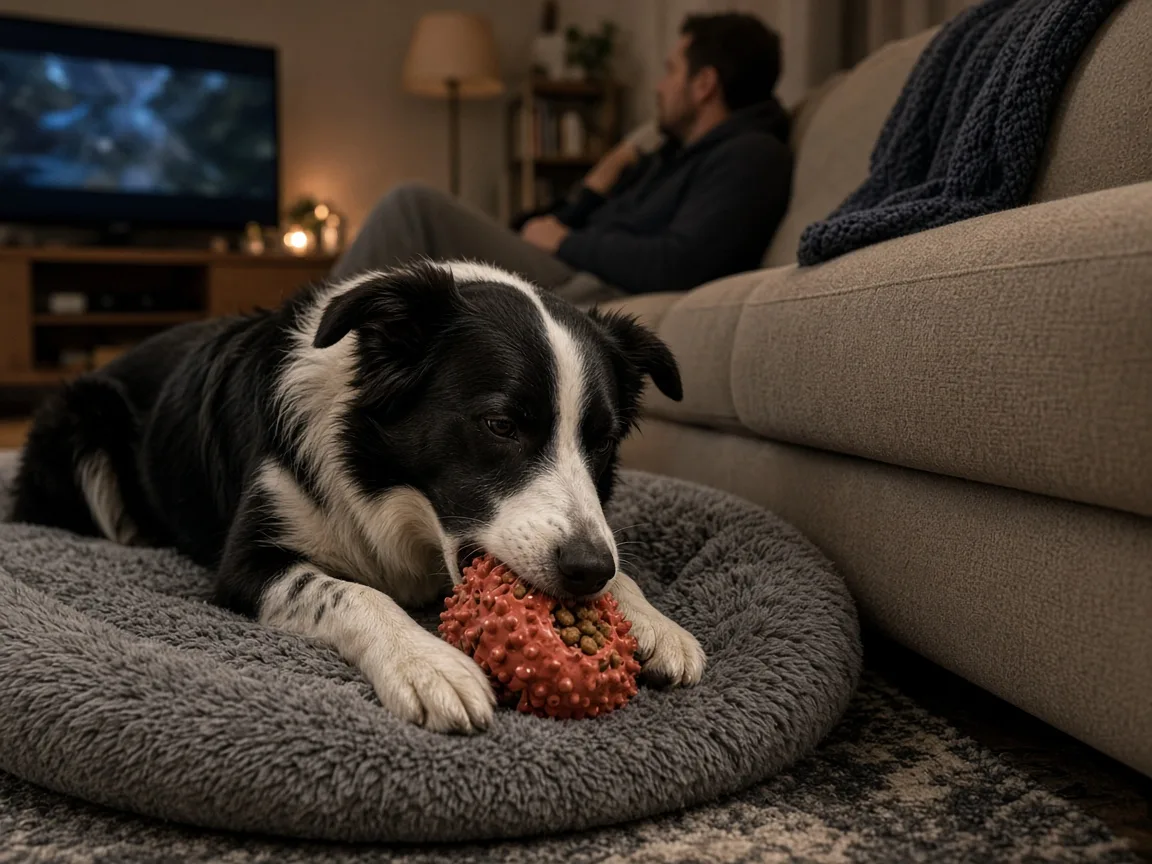 The goal is a dog who stays on the bed when the TV doorbell rings.
If your dog is between 6 months and 8 years, confident, and alert barks at TV doorbells and knocks, Click Here to see how the handheld cue works and who it is for.
Click Here If Your Dog Barks At TV Doorbells
Frequently asked questions
Why does my dog bark at the doorbell on TV?
The VCA says dogs cannot tell TV noises like a doorbell from real ones: Cornell lists a doorbell on television as a trigger for alert barking. To your dog, it sounds like someone is at the door.
Why does my dog bark at the TV doorbell if we do not have a doorbell?
Many owners on Reddit report this: dogs may react to the sound itself, to the people on screen reacting, or to dogs on screen barking. The VCA also notes there is no matching smell, which can confuse dogs.
How do I stop my dog from barking at the doorbell on TV?
Lower the volume, then give a treat as soon as the doorbell sound plays and keep treating while your dog stays quiet, as the VCA describes. Stop the treats when the sound ends: practice with recorded scenes and raise the volume slowly.
Should I mute the TV forever?
No. Muting or skipping scenes is a short term tool while you train: the goal is a dog who hears the sound and looks at you instead of barking.
Will my dog grow out of barking at the TV?
Some do settle with time, but many need practice: Reddit owners describe dogs who barked at TV doorbells for years. Training the sound to mean a treat is more reliable than waiting.
Is barking at the TV a sign of anxiety?
Sometimes. Science News reported that more anxious dogs in an Auburn study reacted negatively to TV doorbells and doors opening: trembling, hiding, or trouble settling are reasons to talk to your vet.
Can I use a bark deterrent for TV barking?
Only as a brief interrupter for a confident dog during practice, and never for a fearful dog. LoveMyPuppy's handheld cue is for dogs 6 months to 8 years. The AKC and ASPCA caution that devices are not a fix on their own.
Does yelling help my dog stop barking at the TV?
Usually not. The ASPCA says a dog barking at a perceived visitor may ignore scolding or yelling, and that punishing a fearful dog can make barking worse. It also says not to ask "Who's there?" or jump up to look, which can encourage barking. Calm treats after the sound work better.
Reviewed November 16, 2026. Advice checked against the VCA, Cornell's Riney Canine Health Center, the ASPCA, the AKC, Preventive Vet, and Science News. Product details come from the LoveMyPuppy product page. Personas are invented examples. If your dog seems fearful, aggressive, or unwell, talk to your vet.